Pressure equipment · Welding & NDE · Structural · Shutdowns
This is what you hand the client.
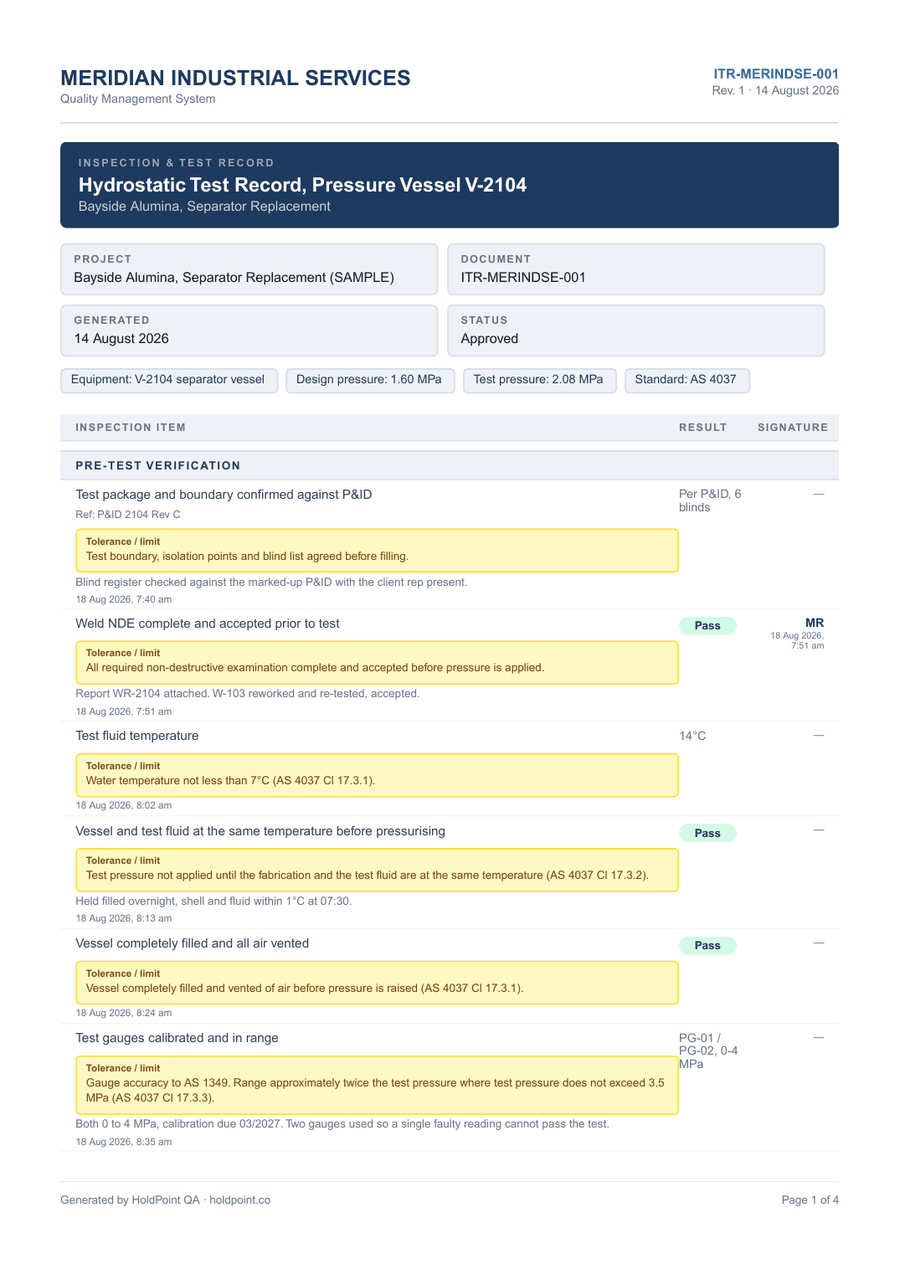
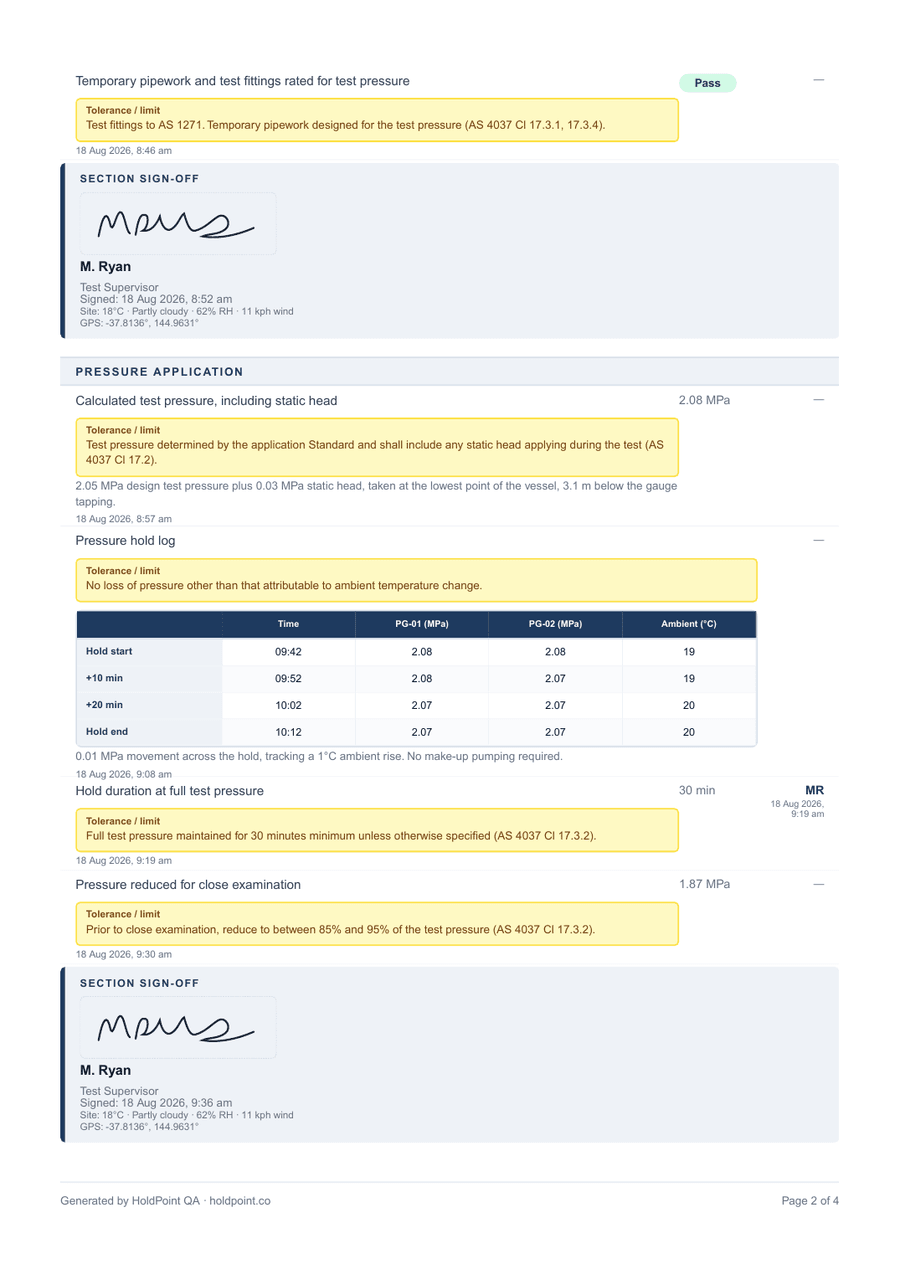
Every reading against the limit it is judged by. Hold points marked. Signed on site, stamped with the time, place and weather, and locked the moment it is approved. That is the whole product, and it is what comes out the other end of a job.
No credit card. Or generate one now with the free ITR tool, no account needed.
Readings go where readings belong.
A pressure hold over thirty minutes. Four weld numbers with their NDE result. Plumb at six columns against the allowable. These are tables, so they are tables here, filled in on a phone at the workface and printed into the record exactly as entered.
The alternative is a photo of a paper sheet in a handover pack, which is what most of this industry still hands over.
The suite
Everything the record needs, in one place.
A tolerance on every row
ITRs carry the limit each reading is judged against, not just a tick. Hold and witness points are marked on the record itself.
Measurement grids
Pressure held over time, weld registers, plumb surveys across a bay. Rows and columns you define, filled in on a phone at the workface.
Installers without accounts
Send a link to a subcontract crew. They fill in their sections and sign on their phone. No licence, no login, no training day.
Records that lock
Once approved, a record is immutable and stamped with the time, place and weather it was signed in. That is what makes it evidence.
Built for the scale of the job
Structure work by area, level, lot or equipment number, apply a master plan across all of them, and hand over one pack per area.
A starting point from your documents
Import an OEM punchlist as a draft to work from, rather than retyping forty checks by hand. You review it before it goes near a job.
Custom software
And the parts that are still in a spreadsheet.
Most industrial contractors run their shutdowns out of one enormous Excel workbook. Work packs, scope, progress, labour, plant, sign-off chains, all of it. It works, right up until two people open it at once, or the person who built it leaves.
We build that properly, on top of the QA records you are already keeping. Same team, same product, extended to fit how you actually run a job.
Discovery, paid and fixed
Two or three weeks with your workbook and the people who use it. You get a written spec with a fixed price attached, and it is yours either way.
Built configurable, not bespoke
Your work pack types, custom fields, workflow states and approval chains become configuration rather than code, so it stays maintainable.
Rolled out with your crews
Migration from what you run now, training, and a pilot on one job before it goes anywhere near a live shutdown.
We will tell you which parts are worth building and which parts Excel genuinely does fine. A shorter scope that gets used beats a bigger one that does not.
Set up a live job first. The custom conversation is easier once we can both see your own records in it.
Questions
- How is this different from a generic inspection app?
- Most inspection apps give you a checklist and a tick box. Industrial QA needs the limit the reading is judged against, the measurement table it goes in, and a record that holds up when a client disputes it two years later. That is what this is built around.
- Can you digitise the spreadsheets we still run on?
- Yes, and it is the most common request we get. Most industrial contractors run shutdowns out of one large Excel workbook. We start with a paid discovery phase: we sit with the workbook and the people who use it, then come back with a spec and a fixed price. Some of it becomes software, and some of it Excel genuinely does fine, which we will say plainly.
- Do our subcontractors need licences?
- No. Installers and subcontract crews work from a link, fill in their sections and sign on their phone. Your team keeps the final sign-off.
- Which standards does it support?
- The record carries whatever standard the work is done to, named on the row it applies to, whether that is AS 1210, AS 4037, AS/NZS 1554.1, AS 4100 or a client specification. The tolerances come from your spec, not from us.
Put one job in and look at the record it produces.
14 days free, no credit card. Set up a real job, send a link to a crew, and read the signed PDF that comes out the other end.